India
India United States
 United Kingdom
 Australia
 Europe
 Gulf countries
Online vs Face-to-Face Tuition: Which One Works Better in 2026?
Posted on 01 July 2026 by Jaya's Academy


You're currently exploring Jaya's Academy Indian website. For the Jaya's Academy US website, click the button below:
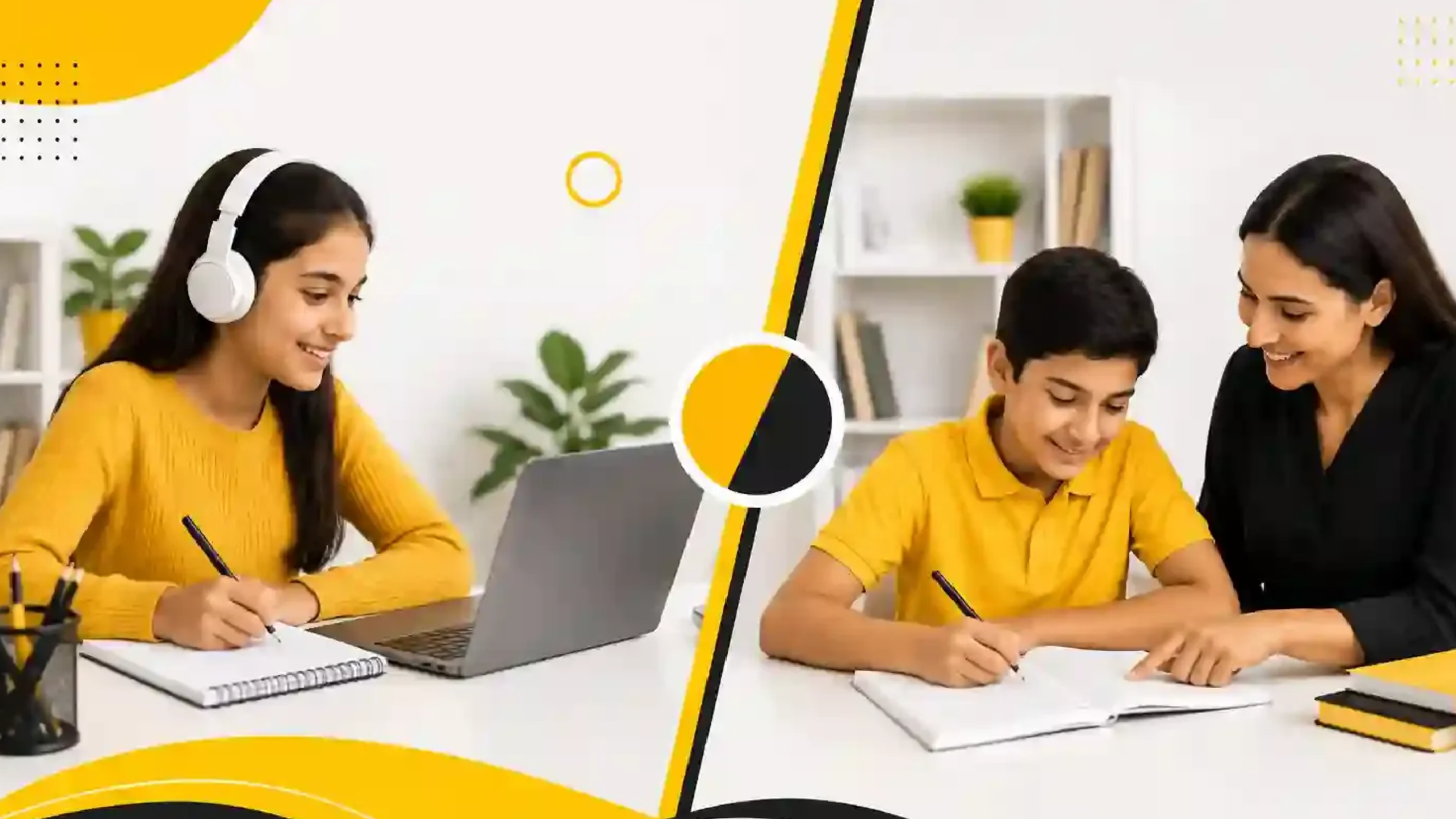
Every parent reaches the same question eventually. Their child needs extra academic support; and the immediate decision that follows is not which subject or which tutor, but which format. Online or face-to-face tuition. Sitting at a veranda or kitchen table with a physical tutor, or logging into a live tutoring session from the comfort of your home?
In 2026, this is no longer a question of preference alone. The landscape of private tuition in India has shifted significantly over the past few years, and families now make this decision with access to far more evidence than they did even a decade ago. This blog examines both formats honestly — what each does well, where each falls short, and how to think about the choice for your child's specific situation.
It is worth being clear about the context before comparing the two formats. The version of online tuition that existed in 2020 during the pandemic; hastily assembled video calls with poor audio, unreliable platforms, and tutors who were not trained to teach through a screen, is largely a thing of the past. In 2026, live online tuition is a mature, well-developed format with platforms built specifically for education, tools for real-time whiteboarding, shared documents, and instant feedback mechanisms that simply did not exist a few years ago.
This does not mean that face-to-face tuition has disappeared. For certain students, under particular circumstances, it remains the format that works best. The goal here is not to declare a winner, but to help parents make a clear decision rather than defaulting to whichever format feels more familiar.
In a well-run online tuition session, a student logs in at a scheduled time and connects directly with a dedicated tutor. The session is live and not pre-recorded, not a video to watch any time, but a real-time, interactive conversation between the tutor and student. The tutor can see what the student is writing, correct errors as they happen, ask questions to probe understanding, and adjust the pace based on how the student is responding.
This is exactly how online tuition is structured by us. Sessions are one-on-one, live, and built around the student's school syllabus — whether CBSE online tutoring, ICSE online tutoring, IB online tutoring, or IGCSE online tutoring. The same tutor works with the same student throughout the academic year, which means continuity is built into the model from the start.
For most Indian families, the single most practical advantage of online tuition is flexibility; and in 2026, this matters. School timetables are packed. Extracurricular commitments, family routines, and long commutes leave limited windows for learning. Travelling to and from a tuition centre during peak traffic hours, particularly in metros, adds time to an already stretched day, and that additional pressure is not neutral. It affects how alert and ready a student is when they actually sit down to learn.
Online tuition eliminates the need for hectic commuting. A session can happen from home, from a grandparent's house during holidays, using any stable internet connection. Scheduling is significantly more flexible, and missed sessions are far easier to reschedule without the logistical disruption that face-to-face arrangements typically involve. For students in cities where traffic is a daily reality — Mumbai, Bengaluru, Delhi, Chennai — the time saved from removing a commute is not trivial. It is frequently the difference between a student arriving at a session composed and ready to learn versus arriving tired and mentally depleted.
This is an important clarification that often gets lost in the online versus face-to-face debate. The most significant factor in learning outcomes is not whether tuition is delivered online or in person — it is whether the session is one-on-one or shared with other students.
A one-on-one session, whether online or in-person, allows the tutor to focus entirely on a single student. Every explanation is tailored. Every question the student has gets answered. Every topic where understanding is shaky gets addressed immediately, not in a later session, not after fifteen other students have had their turns, but right then. The tutor knows exactly what this student has covered, exactly where the gaps are, and exactly what needs to happen next.
A group session, whether online or in a physical tuition centre, cannot offer this. The tutor must manage pace across multiple learners, which means some students are always either bored or lost at any given moment.
Jaya's Academy operates exclusively on a one-on-one model regardless of the subject or curriculum. Whether a student needs CBSE Maths tutoring, ICSE Chemistry, IGCSE Physics, or IB Maths HL, every session is built around one student and one tutor. That structure is what drives real academic progress, and it is achievable online without compromise.
Now the most important question asked by parents: do students actually learn better online? The honest answer is that the format itself is a less important predictor of outcomes than the quality of the tutor, the consistency of sessions, and the degree of personalisation.
Students who attend regular, consistent one-on-one sessions with a well-matched tutor make strong academic progress. Students who attend irregular group sessions, regardless of format, make weaker progress. The format shapes convenience and access. The quality of the teaching and the structure of the sessions shape the results.
What the evidence does consistently show is that online one-on-one tutoring, when done properly, produces outcomes that are at least equivalent to in-person one-on-one tutoring — and often superior, because the flexibility of the format makes consistency more achievable. A student who attends twelve sessions online is almost always more advanced than a student who attends eight sessions in person with four cancellations due to logistics.
This is especially true for subjects where building on prior knowledge is critical. Maths is the clearest example. A student who misses CBSE Maths sessions because of travel challenges or timetable clashes accumulates gaps. These gaps compound. Online classes make it significantly easier to maintain the consistent nature of classes.
For very young students — particularly primary school children who are still developing the ability to sit at a screen and concentrate for extended periods — in-person tuition can be more effective simply because the physical presence of another adult in the room is more engaging for that age group. The sensory reality of someone sitting next to them, pointing at a page, and responding to their body language can be more effective than a screen for these students.
For students with certain learning challenges or differences, particularly those who struggle with the sensory aspects of screen-based interaction, in-person tuition may also be preferable. A face-to-face environment can be easier to read and respond to for some students.
And for practical subjects with a hands-on component — though this applies less to the academic subjects that private tuition typically covers — in-person instruction has obvious advantages.
These are real cases. But for the majority of secondary school students studying subjects like Maths, Science, English, or a second language across CBSE, ICSE, IB, or IGCSE, there is no equivalent practical advantage to being in the same physical space as the tutor. What matters is the quality of explanation, the ability to ask questions freely, and the consistency of attendance — all of which online tuition handles effectively.
For families in India navigating the choice across different curricula, a few subject-specific points are worth noting.
For CBSE Biology and ICSE Biology, diagrams and visual explanations are central to understanding. Online tutoring platforms with whiteboard tools and screen-sharing allow tutors to walk through diagrams in real time, which is at least as effective as doing so on paper in person — and often more so, because the tutor can annotate, zoom, and highlight in ways that a physical diagram does not allow.
For IGCSE Chemistry and CBSE Chemistry, the conceptual and problem-solving components — which make up the majority of marks at this level — are well-suited to online instruction. The same applies to GCSE Maths and IGCSE Maths, where working through problems step-by-step on a shared virtual whiteboard mirrors the experience of working alongside a tutor in person.
For English — whether CBSE English, ICSE English, or IGCSE English — the core skills of comprehension, writing, and analysis lend themselves naturally to online delivery. Essays can be shared and annotated live. Comprehension passages can be read and discussed in real time. The back-and-forth of analytical discussion that good English tutoring requires works well through a live video connection.
Online tuition is generally more affordable than equivalent in-person tuition in India, for reasons that are straightforward. Without travel time factored into the tutor's session planning and without the overhead costs of a physical centre, well-run online tuition programmes can offer competitive pricing while maintaining high tutor quality.
For families where the cost of private tuition is a meaningful consideration; and for most Indian families it is, this matters. The ability to access a qualified, experienced tutor for a subject like IB Maths SL or IGCSE Physics without the additional costs associated with in-person arrangements is a genuine financial advantage.
One thing that rarely gets discussed in the online versus face-to-face debate is tutor consistency, and it may be the most important variable of all.
When a student works with the same tutor over an extended period, the tutor builds detailed knowledge of that student. They know which topics the student finds intuitive and which require more time. They know how the student responds to being challenged. They know the specific errors the student tends to make in exam conditions. That accumulated knowledge is what makes the difference between a tutor who teaches and a tutor who genuinely understands how to help this particular student improve.
Online tuition makes consistency more achievable because sessions are not disrupted by travel, geography, or scheduling difficulties that often force in-person arrangements to change tutors. At Jaya's Academy, the same tutor works with the same student throughout the year by design — and our experience over 15 years and more than a million sessions confirms that this consistency is one of the strongest predictors of student progress.
For a closer look at how molecular biology concepts like DNA replication are best tackled in a consistent, structured tutoring environment, our blog on DNA and Protein Synthesis in IGCSE Biology illustrates exactly why depth of understanding — built session by session over time — matters more than any single exam technique.
The popularity of home tuition India remains strong, but advancements in online learning platforms have given students access to expert tutors regardless of their location.
For most secondary school students in India in 2026, online tuition certainly works better for most students; not because being online is inherently superior, but because the format makes it significantly easier to achieve the three things that actually drive academic progress: regular attendance, personalized one-on-one attention and tutor continuity. The right question for parents to ask is not "online or in-person?" but rather "will my child have the same tutor each week, will sessions be one-on-one, and will the content be aligned with what is being taught at school?" If the answer to all three is yes, the format matters far less than most people assume.
If you would like to explore how Jaya's Academy's live, one-on-one online tuition in India works in practice, book a free consultation and demo session with our team. There is no obligation — just a chance to see the format in action and decide whether it is the right fit for your child.

We enrolled our son in Grade 7 CBSE Maths and Science classes, and the improvement has been very noticeable within just a few months. The tutors explain concepts clearly and ensure he practices regularly. His confidence has gone up, and his recent exam scores reflect that. The structured approach really works.


My daughter always struggled with English writing and comprehension in ICSE. What stood out here was the one-on-one attention she received. The tutor understood her weak areas and worked patiently with her. Now she writes much more confidently and even enjoys the subject.


As parents, we were looking for someone who understands the IGCSE curriculum properly. The tutors here are well-versed with the syllabus and exam pattern. Our child now finds both Maths and Science much easier to handle, and the clarity in concepts has improved significantly.


Managing school, activities, and tuition was becoming difficult. Online classes made things much more convenient for us. The scheduling is flexible, and the classes are interactive enough to keep our child engaged. It has saved us time while still ensuring good learning outcomes.


The biggest change we have seen is in our child’s confidence. Earlier, she used to hesitate to ask questions, but now she actively participates in class. The tutors encourage curiosity and make learning enjoyable. It is not just about marks, but overall development.